
You know that email you meant to reply to last spring? The one that’s We’ve all had that moment…you’re halfway through explaining how to do something, and it hits you: I’ve done this exact explanation before.
Maybe twice.
Maybe fourteen times.
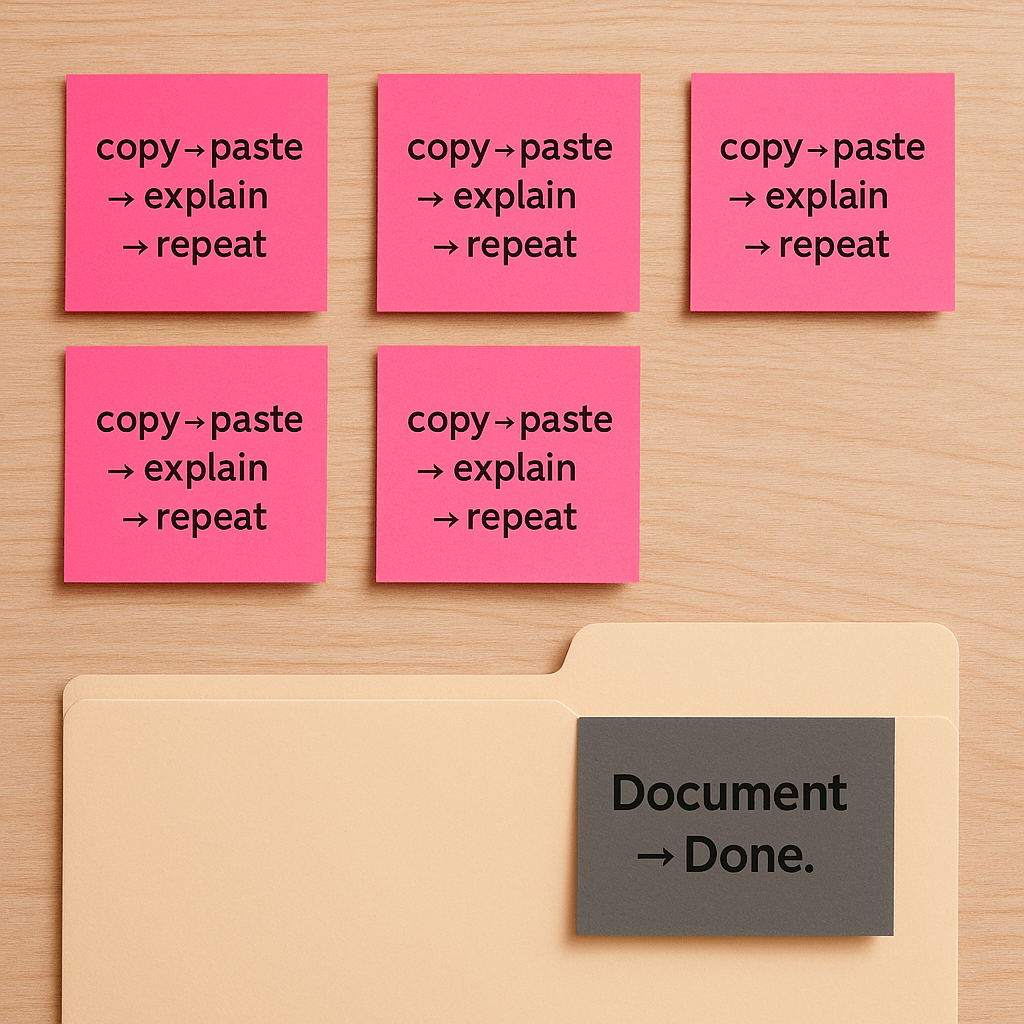
Maybe you’ve even sent the same screenshot with the same little red arrow because, at this point, it’s part of your personality.
You say it patiently (or at least, you sound patient) while silently wondering if it would be faster to just do it yourself. Again.
Welcome to the endless loop of repetition tax.
It’s the hidden cost of running a business that lives in your inbox and DMs. The cost of retyping, re-forwarding, re-demonstrating, and re-questioning your own sanity.
“Just Doing It Myself” Is the Most Expensive Choice
We all start there. You tell yourself it’s easier to just knock it out quickly than to slow down and teach someone else how to do it.
Except “quickly” turns into “permanently.”
Because now you’re the only one who knows how it’s done.
Suddenly, every task comes with a built-in interruption. Every handoff comes with a follow-up. And every time you try to delegate, you find yourself right back in the trenches, explaining the same three steps in slightly different words.
You’re not delegating, you’re babysitting.
The SOP Nobody Asked For (But You Desperately Need)
Here’s the part where some people start twitching because I said “SOP.”
It sounds so…corporate.
Like something that lives in a binder next to a dress code policy and a three-step handshake for department meetings.
Let’s fix that right now.
An SOP (Standard Operating Procedure, if we’re being formal) is not a corporate relic. It’s just you, writing down how you do something when you do it right.
That’s it. No corporate jargon, no PowerPoint, no twenty-page manual.
It’s literally, “Open Canva, copy the last month’s template, swap the photos, check alignment, export, post.”
Boom: you just made an SOP.
Why This Matters (Even If You Work Alone)
You might think you don’t need to document anything because you’re the only one doing it.
But future-you would like a word.
Future-you is tired. Future-you is juggling twelve other things. Future-you does not remember which spreadsheet formula worked or what folder you saved that client asset in.
SOPs aren’t just for teams, they’re for your sanity.
They’re a way of leaving breadcrumbs so you can pick up right where you left off without wondering, “Wait…how did I do this last time?”
It’s like labeling your Christmas decorations before you stick them in the attic. You think you’ll remember. You won’t.
The Moment It Pays Off
I once worked with someone who swore they didn’t need documentation because “it’s all in my head.”
Spoiler: it was not.
Fast-forward to December, when half their team was out sick, and they had one of those “why do I do this to myself” moments.
But there was one task, one glorious, documented task, that ran smoothly without them.
No questions, no chaos, no crisis.
That’s the magic moment.
That’s when you realize writing down how something works isn’t busywork…it’s a lifeline.
The Gift You Give Yourself
The real beauty of an SOP is that it’s the one thing in your business that gives back.
You write it once, and it works for you every single time after that.
It’s like cloning your calmest, most organized self: the one who isn’t frazzled, behind, or typing instructions from the driver’s seat of their car before an appointment. SOPs aren’t about control; they’re about freedom.
They give you back your brain, one documented process at a time.
 Backwoods Consulting
Leave a comment