
I genuinely thought that once everything was organized (inbox at zero, files cleaned up, systems dialed in), I’d finally be able to sit down, open my laptop, and just…work.
That’s the promise, right?
Get organized and productivity will follow.
Except it didn’t.
Even with everything “in order,” I was still taking forever to get things done. I was still bouncing around, still feeling scattered, still struggling to find what I needed when I needed it. And what made it extra frustrating was that I couldn’t figure out why. On paper, everything looked great. The mess was gone. The chaos was handled.
So why did it still feel so hard?
When Organization Isn’t the Fix You Thought It Was
What I eventually realized was that I hadn’t just organized my work…I had over-organized it.
I had too many workspaces. Too many browser tabs open for each client, even though those clients already had their own systems. My inbox was beautifully sorted, sure, but it had so many layers of folders that pulling up one message took far longer than it should have.
Everything had a place.
There were just too many places.
Instead of feeling streamlined, I was constantly bouncing between tabs, workspaces, folders, and tools, trying to keep all the plates spinning at once. It felt productive. It looked productive. But nothing was actually getting finished.
The Moment It Finally Clicked
The real problem wasn’t hiding in my inbox or my file system. It was staring at me from the top of my browser window.
My tabs were crowded, and so was my mind.
I kept hopping from tab to tab and workspace to workspace because I had this persistent feeling that I was missing something somewhere. An email. A task. An article I’d saved for a client. Something important that would slip through the cracks if I didn’t keep checking.
Here’s the thing, though: I wasn’t missing anything.
What I was doing was chasing tiny dopamine hits: catching a new email, replying quickly, remembering to check something, feeling momentarily “on top of things.” I told myself it made me more available and more responsive, and therefore better at my job.
In reality, I was blowing straight past the boundaries I thought I’d carefully put in place.
That’s distraction debt.
And it compounds faster than you realize.
Why Focus Gets Harder After You Get Organized
Once your systems are clean, everything becomes accessible. And when everything is accessible, everything competes for your attention.
Admin tasks suddenly feel urgent. Checking messages feels responsible. Switching tasks feels like momentum. But all that switching quietly eats your time, drains your energy, and makes even simple work feel exhausting.
You don’t just lose minutes here and there.
You lose entire days. Sometimes weeks.
Why Your Attention Needs a Chaperone
This wasn’t about motivation or discipline. It wasn’t a willpower problem.
It was an attention problem.
So instead of trying to “be better” at focusing, I started putting actual guardrails around my attention. I kept my workspaces but drastically reduced the number of open tabs. Each client has a favorites folder with only the sites I actually need, so I’m not hunting. Each workspace has one primary tab open, plus my inbox, and that’s it.
I work from a weekly list that tells me exactly what needs to be done each day, and I physically check things off as they’re completed. For my social media clients, I built a master spreadsheet that’s color-coded so I can tell at a glance what’s been created, scheduled, or still needs attention…and whether I have room to take on an emergency project without derailing everything else.
And then there’s the part that really changed things.
I set a timer.
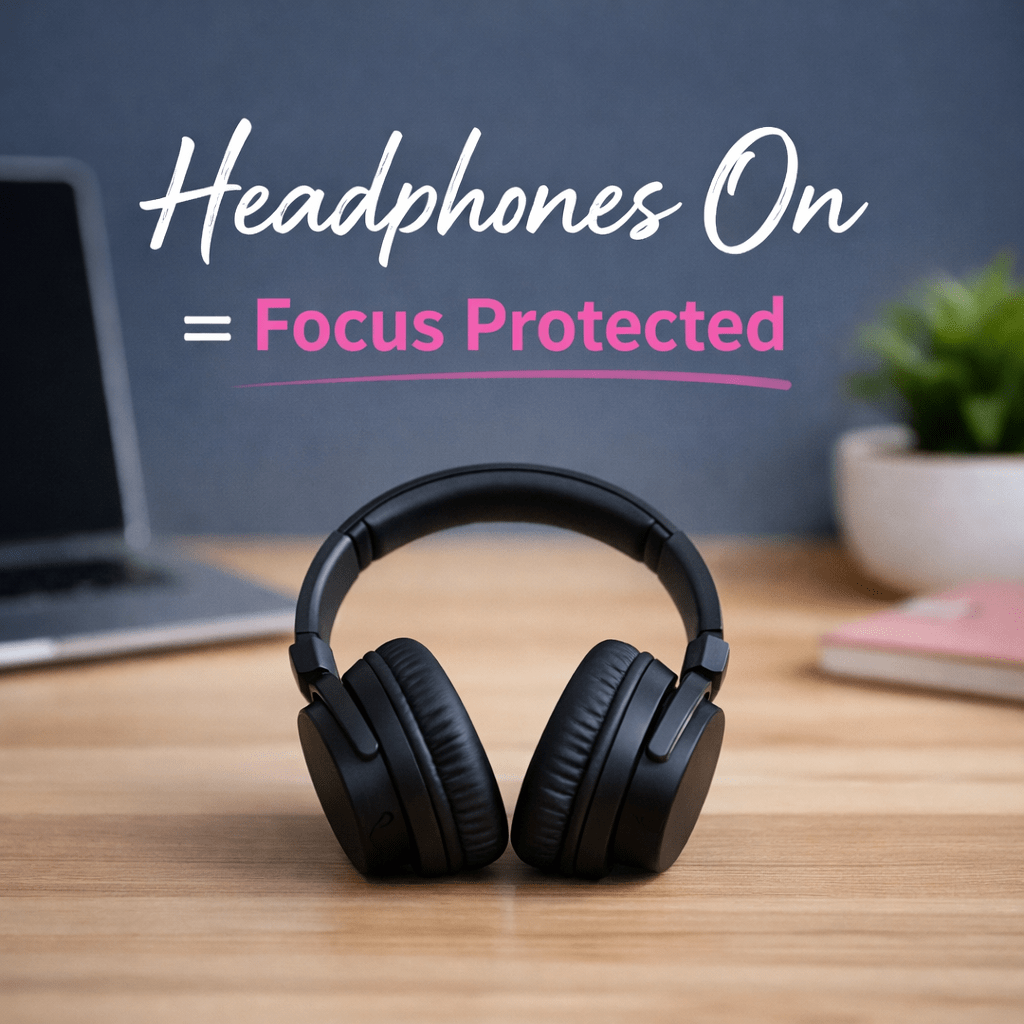
I go back to my in-house legal days, put on classical music, pop in my earbuds, and work for the specific amount of time I’ve set for that task. Since I work from home and homeschool, the kids get their own clearly defined projects, and they know that earbuds in means I’m unavailable unless something is truly urgent.
At first, I felt a little ridiculous. Like I was overdoing it.
Now? It’s a habit I won’t give up.
The Real Issue Isn’t Focus, It’s Dopamine
This isn’t just about attention spans or productivity hacks. It’s about the constant dopamine hits we’re trained to seek in a digital world that never stops nudging us.
So here’s the honest advice I wish I’d taken sooner:
Put your phone on silent. Better yet, leave it in another room. Close anything on your computer that can pop up and steal your attention. Turn off notifications. Reduce the visual noise.
Then get to work.Because if you clean up your systems but don’t protect your attention, the work still won’t get done…and you’ll be left wondering why something that should be easier somehow feels just as hard as before.
 Backwoods Consulting
Leave a comment