
Let’s talk about your to-do list for a minute.
Not the fresh one you make when you’re feeling optimistic. Not the rewritten version that magically appears on Monday mornings or during a “get my life together” moment. I’m talking about the real one — the one that quietly follows you around week after week, collecting the same tasks like souvenirs.
You know the ones.
They’ve been there long enough that you don’t even read them anymore. You just recognize them. Familiar. Persistent. Slightly judgmental.
If a task has been sitting on your to-do list for a month, it’s not a task anymore.
It’s décor.
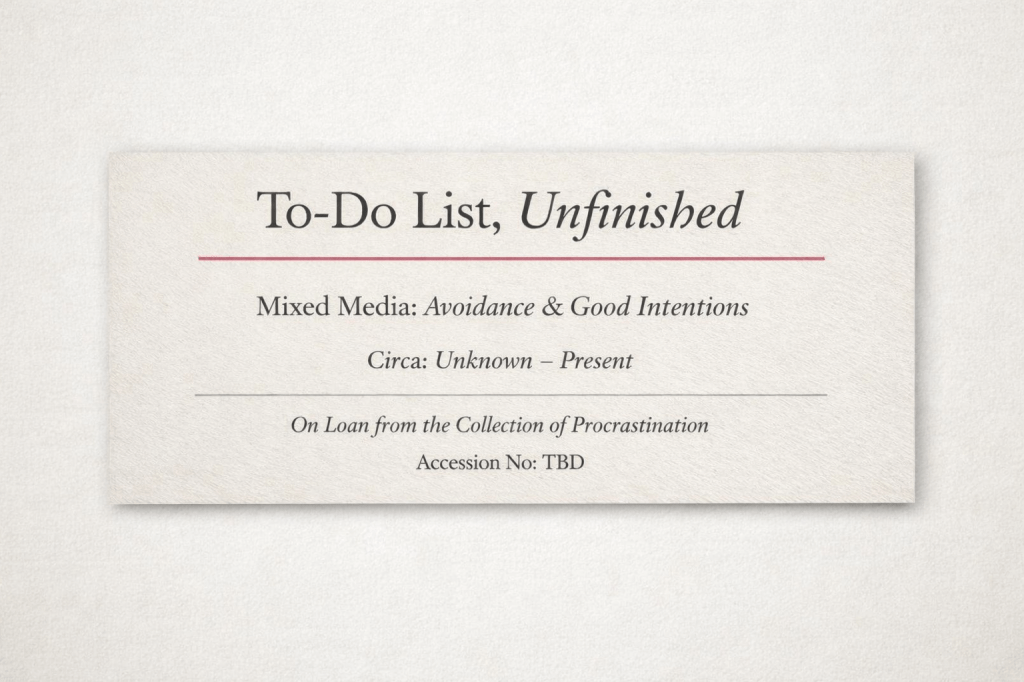
You’re not managing work at that point — you’re curating an exhibit.
The Quiet Weight of Unfinished Things
Here’s the sneaky part about old tasks: they don’t scream for attention. They whisper.
Every time you glance at your list and see something you meant to do (but didn’t), your brain registers it as unfinished business. Not urgent enough to act on but not resolved enough to ignore.
That tiny mental ping adds up.
It’s a low-grade pressure that lives in the background while you’re answering emails, handling client work, or trying to focus on something new. And eventually, your brain starts associating your to-do list with guilt instead of clarity.
So you avoid it. Or you rewrite it. Or you start a brand-new list that feels productive for about ten minutes.
None of those things fix the problem. They just move the dust around.
Why Stale Tasks Kill Momentum
Momentum doesn’t die because you’re busy. It dies because you’re carrying too much unresolved weight.
When tasks linger too long, they stop feeling actionable and start feeling symbolic; reminders of decisions you haven’t made, systems you haven’t fixed, or priorities you haven’t sorted out yet.
Your brain doesn’t like that kind of ambiguity. So instead of moving forward, it hesitates. It stalls. It procrastinates…not out of laziness, but self-preservation.
Stale tasks don’t motivate action. They train avoidance.
And the longer they sit there, the harder it feels to start anything at all.
The Three Types of Museum Pieces
Most long-standing tasks fall into one of three categories. Once you see which one you’re dealing with, the fix becomes a lot clearer.
First, there’s the avoided decision.
These aren’t really tasks, they’re choices wearing trench coats.
- “Figure out software.”
- “Decide pricing.”
- “Pick a direction.”
No amount of time will magically complete these. They require a decision, and decisions carry responsibility. So they sit there, waiting for the mythical moment when clarity arrives on its own.
(It won’t.)
Then there’s the vague monster.
These sound important, but they don’t mean anything concrete.
- “Work on website.”
- “Fix backend.”
- “Get organized.”
Your brain can’t take action on fog. Without a clear starting point, these tasks feel heavy and undefined, which makes them incredibly easy to avoid while still feeling “important.”
And finally, there’s the should-do relic.
This one hurts a little.
It made sense once. It just doesn’t anymore.
But deleting it feels like admitting something…maybe that a season has changed, or that an idea didn’t pan out, or that past-you had different priorities. So instead of letting it go, it stays. Quietly judging you from the list.
Why “Just Do It” Isn’t the Answer
This is where most productivity advice goes sideways.
You don’t need more discipline.
You don’t need better motivation.
And you definitely don’t need to “try harder.”
If a task has survived weeks or months untouched, the problem isn’t effort. It’s clarity.
Discipline doesn’t solve poorly defined work. Motivation doesn’t fix unresolved decisions.
Most of the time, what you’re experiencing isn’t procrastination…it’s hesitation. And hesitation is usually a signal that something needs to be clarified, simplified, or released.
You’re not lazy. You’re overloaded or undecided.
That matters.
One Simple Rule That Clears the Fog
You don’t need a new system to fix this. You just need a rule.
If a task has been on your list for 30 days, it has to be reassigned to one of four actions:
- Decide it
- Break it down
- Delete it
- Defer it — with an actual date attached
That’s it.
No fifth option. No “leave it there and hope it resolves itself.”
If it stays on the list, it has to move.
This one rule forces clarity. And clarity is what creates momentum.
What Momentum Really Looks Like
Momentum isn’t about speed. It’s about friction.
When you know exactly what the next right action is, even if it’s small, your brain relaxes. There’s no debate. No internal negotiation. Just movement.
Ten “important” tasks don’t create momentum. One clear next step does.
And the moment you stop letting old tasks haunt your list, everything starts to feel lighter. Quieter. More possible.
Clean the List, Not Your Life
You don’t need a fresh planner.
You don’t need a productivity reboot.
You don’t need to wake up earlier or optimize harder.
You need fewer ghosts on your list.
Clear the exhibits.
Make room for movement.
Your to-do list isn’t a museum. It’s a tool.
And tools are meant to be used…not admired from a safe distance.
 Backwoods Consulting
Leave a comment