
Let’s talk about the part no one really wants to admit out loud.
Most people don’t stop using a workflow because it’s bad. They stop because they wandered off. They built it with good intentions, maybe even used it for a week or two, felt a little smug about having their life together…and then life showed up. Energy dipped. Something urgent took over. A step got skipped. And instead of picking it back up, they quietly disappeared from the process like the workflow texted, “hey stranger,” and they weren’t ready to answer.
A few weeks later, they look back at it and decide, “See? Workflows don’t work.”
Except that’s not what happened.
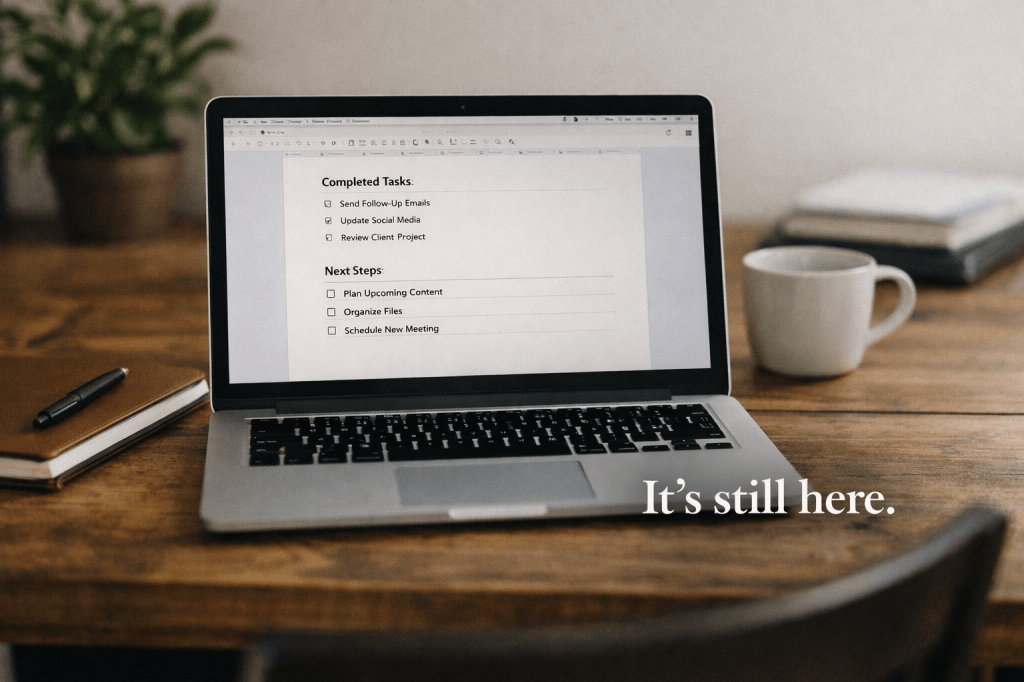
What actually happened is that the workflow didn’t fail…it just got abandoned mid-sentence. A workflow isn’t a magic document that fixes your business the moment you create it. It’s a loop. A rhythm. A living thing that only works if you stay in contact with it. When you ghost it, it doesn’t break dramatically or throw an error. It just sits there quietly, waiting. And the longer you’re gone, the heavier it feels to come back.
This is usually where people make things worse by starting over. They build a brand-new workflow, convinced this one will be different, more realistic, more sustainable. But the issue wasn’t the workflow. It was the disappearing act.
Ghosting a workflow is rarely dramatic. It’s subtle. It looks like skipping one step “just this week,” then never circling back. It looks like keeping the system in your head instead of opening it because you already feel behind. It looks like assuming the process is broken when, in reality, it’s just unfinished. You don’t delete it. You don’t officially quit. You just stop showing up and hope the problem resolves itself.
And honestly? This is incredibly normal.
Consistency sounds great in theory, but real life doesn’t move in tidy weekly increments. One strange week turns into a strange month. Energy shifts. Priorities change. Something urgent steals the spotlight. One skipped check-in quietly turns into six, and by then reopening the workflow feels less like a neutral action and more like admitting defeat. So your brain does what brains are very good at: it protects you from discomfort by declaring the entire system a failure.
But it wasn’t a failure. It was a pause that never got acknowledged.
Here’s the part that surprises people: the fix is not a new system. You don’t need a more robust workflow, a shinier tool, or a total reset. You definitely don’t need to burn everything down and start from scratch. What you actually need is much simpler.
You need to re-enter the loop.
That’s it.
Workflows don’t require perfection to work. They require contact. Staying in relationship with the process matters far more than executing it flawlessly every single week.
At its core, a workflow only needs a simple loop to stay alive. First, you check in. You open it and look at where things actually are, not where you hoped they’d be. Then you nudge one thing forward. Not everything, not a heroic catch-up session, just one piece. After that, you adjust. If a step doesn’t fit your current season, you tweak it instead of abandoning the entire system. And finally, you continue. Not restart. Not overhaul. Just continue from where you are.
That’s the loop. Quiet, functional, and far more forgiving than people expect.
The biggest lie about workflows is the idea that you have to “keep up” with them for them to work. You don’t. You just have to come back. Momentum beats perfection every time, and workflows succeed because you stay engaged with them, not because you never miss a step.
So if you’ve been ghosting a workflow (and most people have) this is your reminder that you don’t need permission to re-enter. You don’t need a clean slate or a perfect week lined up. You can just show up again, touch the system, move one piece forward, and keep going.
That’s how workflows actually start working.
 Backwoods Consulting
Leave a comment