
When I don’t follow my routines, it’s not some dramatic collapse. Nothing catches fire. No alarms go off.
It’s smaller than that…and somehow more exhausting.
A client’s social media post doesn’t get done quite right. Or it gets done late. I tell myself I’ll come back and fix it, then keep moving because there’s already something else waiting. By the end of the day, I’ve been busy nonstop…but I don’t feel finished with anything.
That’s usually my first clue. Not overwhelm. Not stress. Just that low-level feeling of playing catch-up with work I know I’m capable of doing well.
And it’s almost never because I took on too much. It’s because I skipped the routines that normally keep things moving smoothly.
Your Brain Is Not Built for Endless Decisions
What sneaks up on you in those moments isn’t the work itself…it’s the decisions layered on top of it.
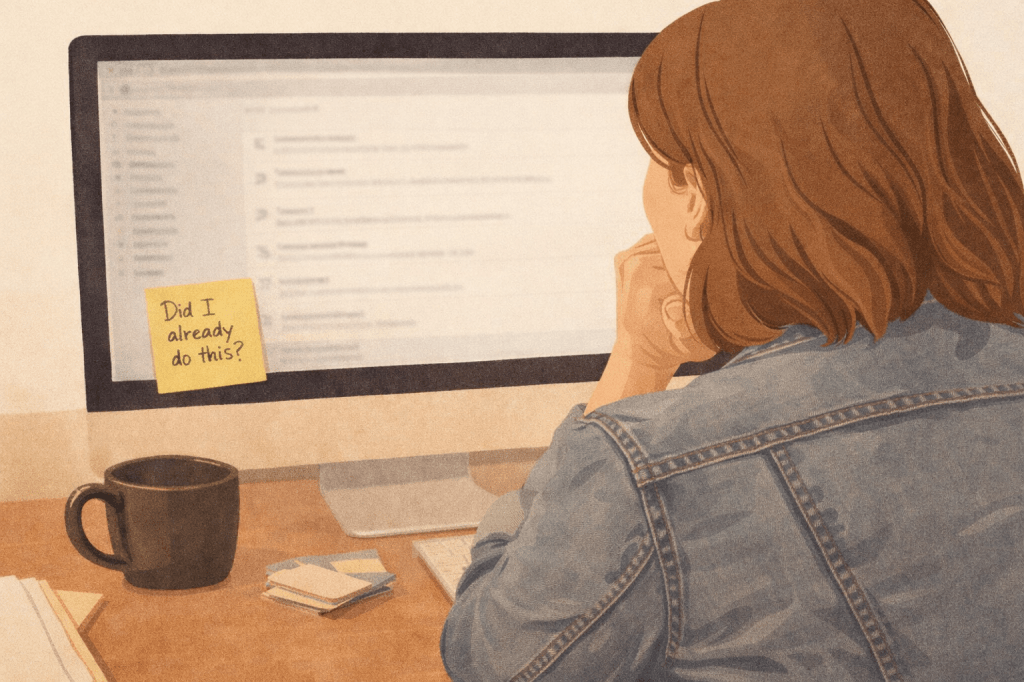
When routines slip, suddenly every task needs extra thought. How do I usually do this? What’s the order again? Did I already handle this, or am I about to duplicate effort? Those tiny pauses add up fast.
None of those decisions are hard, but they’re constant. And when your brain has to re-decide everything, it burns energy just trying to stay oriented. That’s when work starts to feel heavier than it should.
Routines remove those decisions ahead of time. They quietly answer questions before your brain has to ask them; which is a lot kinder than pushing through on willpower alone.
Chaos Isn’t the Problem: Friction Is
When routines fall apart, what shows up isn’t chaos so much as friction.
It’s the drag of fixing small mistakes that didn’t need to happen. The time spent double-checking things that are normally automatic. The mental load of remembering what’s still undone because nothing followed its usual path.
That friction slows everything down just enough to be irritating. You keep moving, but you don’t feel progress. And when progress disappears, confidence tends to wobble right along with it.
What a Routine Actually Is (and What It Isn’t)
A routine isn’t a rigid schedule or a productivity personality overhaul. It’s not about becoming perfectly consistent or pretending life won’t interrupt you.
A routine is simply this: this happens the same way every time.
When my routines are in place, client work flows. Posts get done correctly and on time because the steps are already decided. I’m not reinventing the process. I’m just executing it.
That predictability isn’t boring. It’s calming. It gives your brain something solid to stand on.
Small Routines Do More Than Big Ones
The routines that matter most are usually the quiet ones.
The order you handle client work. The way you prep before starting a task. The simple checks that make sure nothing gets skipped. When those routines are working, everything else feels easier; not because you’re doing less, but because you’re not stopping to think every two minutes.
And when they’re missing, you feel it immediately. You’re busy, but unfinished. Active, but oddly behind.
That’s not a motivation problem. It’s a systems problem.
Where Routines Usually Fall Apart
Most routines don’t fail because they’re bad ideas. They fail because they live entirely in your head.
You know how things should go. Until you’re interrupted. Or tired. Or trying to move too fast to catch up. Then the routine slips, and suddenly you’re managing everything manually again.
That’s when small things start falling through the cracks. Not because you don’t care, but because the guardrails aren’t there anymore.
An SOP Is Just a Routine That Can’t Evaporate
This is where SOPs earn their keep.
An SOP isn’t a corporate document or a formality. It’s just a routine that’s been written down so it doesn’t disappear when things get busy. It captures the steps you already take, in the order that already works, with the decisions already made.
When a routine becomes an SOP, it stops relying on memory. And when it stops relying on memory, it keeps working even when you’re tired, distracted, or moving fast.
That’s how one SOP can eliminate a surprising amount of chaos.
Give Your Brain a Break
You don’t need more discipline. You don’t need to hustle harder or “lock in” better habits.
You need fewer decisions standing between you and done.
Routines don’t limit you, they protect your focus. They keep small things from slipping sideways and turning into catch-up later. And they give your brain enough breathing room to actually finish what you start.
If work feels harder than it should right now, it’s probably not a personal flaw.
It might just be time to give your brain a routine…and let it do what it does best.
 Backwoods Consulting
Leave a comment