
There’s a part of this whole “get your systems together” thing that nobody really talks about, and it’s not the setup, and it’s not even the cleanup phase.
It’s what happens after everything finally starts working.
Because that’s the point where most people quietly stop.
You get your bookkeeping cleaned up. Everything is categorized, your accounts are reconciled, and nothing is actively on fire anymore. For a brief moment, it feels like you’ve finally cracked the code.
And then…you back off.
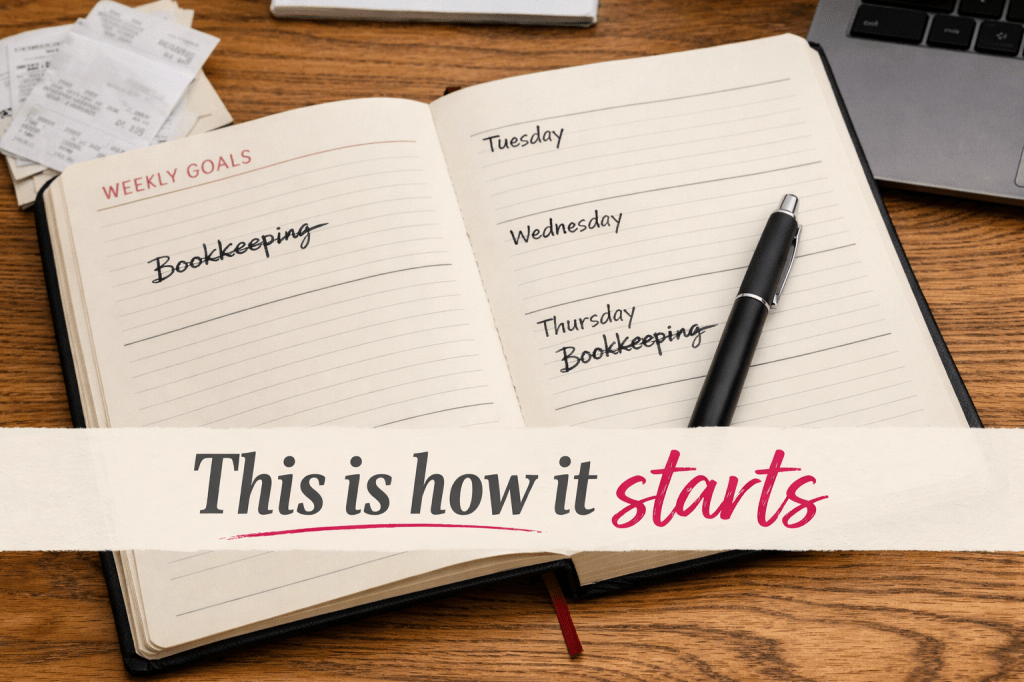
Not in some dramatic, all-at-once way. It’s subtle. You skip a week because things are busy. Then another. Then you tell yourself you’ll just catch everything up at the end of the month since it’s “not that bad yet.”
And just like that, you’re sliding right back into the same mess you worked so hard to get out of.
Here’s the part most people don’t want to admit:
The system didn’t fail you…you stopped using it.
Once your bookkeeping is set up properly, it’s not complicated. It’s repetitive, predictable, and honestly a little boring. But that’s exactly why it works. When something is simple and consistent, it doesn’t require motivation or a burst of energy. It just requires you to keep showing up and doing the same small things over and over again.
That’s it.
But instead, what usually happens is that transactions start piling up, and you don’t quite remember what that one charge was for, so you leave it for later. Then “later” turns into a backlog, and the backlog turns into avoidance, and before long you’re back to opening your books, staring at the screen, and wondering how it got this bad again.
(You already know how it got this bad again.)
A system isn’t a one-time fix. It’s not something you build once and then admire from a distance like a freshly cleaned garage.
It’s a habit.
And if the habit slips, the system doesn’t kind of work…it stops working altogether.
The good news is, you don’t need to reinvent anything here. You don’t need new software, a better spreadsheet, or some completely overhauled workflow.
You just need to keep the one you already built alive.
That looks like sticking to your weekly bookkeeping time, even when you don’t feel like it. It means categorizing transactions while they’re still fresh so you’re not guessing later. It means reconciling regularly so things never have the chance to get fuzzy.
Not when it’s convenient…when it’s scheduled.
Because the second bookkeeping turns into a “when I get to it” task, it stops getting done.
And we both know where that leads.
Nobody is excited to sit down and update their books. No one is waking up thinking, “This is how I want to spend my afternoon.”
But the people who stay out of chaos aren’t waiting to feel motivated. They’re just consistent.
Not perfect…just consistent.
And if you’ve already slipped a little, that’s not the end of the world. It just means you caught it before it turned into a full-blown mess again.
So fix it now, while it’s still manageable. Not next month, not at tax time, and definitely not when it becomes urgent again. Now.
Because you’ve already seen the difference. You know what it feels like to be caught up, to have everything in order, to not be avoiding your numbers.
That didn’t happen by accident.
So now you’ve got a choice.
You can keep the habit and keep things running smoothly.
Or you can let it slide and start the chaos all over again. than being spent on things that don’t actually move the needle.
 Backwoods Consulting
Leave a comment