
There’s this assumption a lot of people carry around — quietly, but constantly:
“I just need to get more organized.”
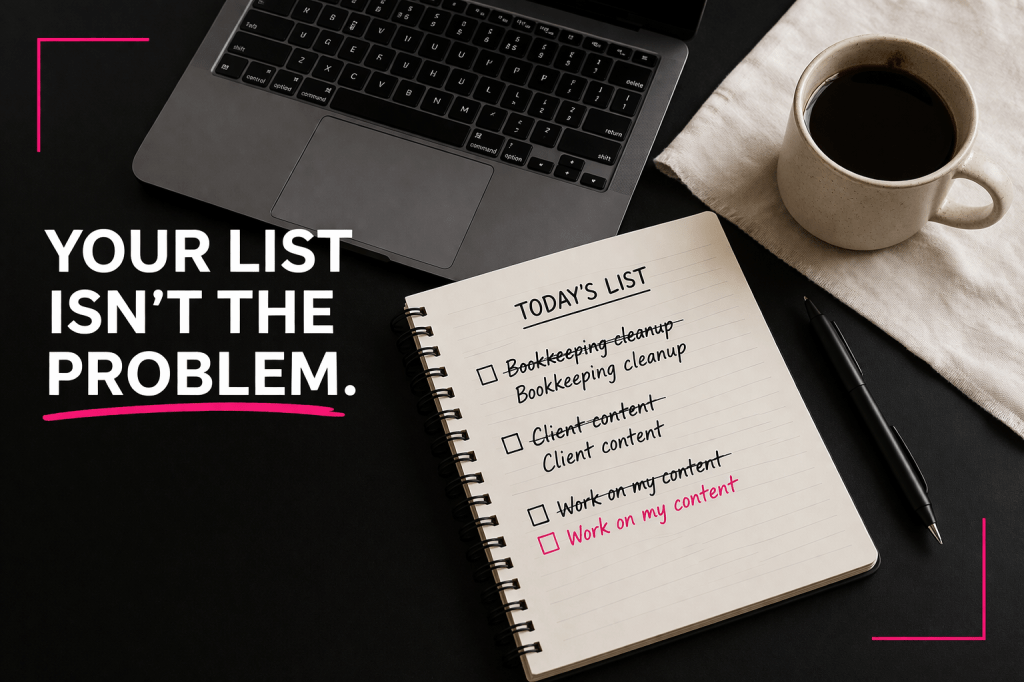
So you try. You rewrite your to-do list, clean up your workspace, open a fresh document, and convince yourself this is the version where everything finally clicks. And yet…somehow…you’re still stuck.
Not because you don’t care. Not because you’re lazy. Not because you don’t know what needs to be done. You just can’t seem to get moving.
Here’s the part no one really says out loud: it’s not disorganization. It’s decision fatigue.
When you sit down to work and immediately feel that mental drag, that hesitation before you even start, it’s usually not about the work itself. It’s about the decisions behind the work. What should I start with? What matters most today? Should I finish this first or jump to that? Am I even working on the right thing?
Individually, those are small questions. Stack them up every single day, though, and they’ll drain you before you’ve done anything meaningful.
It shows up in ways that look productive from the outside. Rewriting your task list. Reorganizing your priorities. Opening one task, then another, then another…waiting for one of them to feel like the “right” place to start. You’re moving, technically. But you’re not actually progressing.
I’ve been there.
I had multiple new bookkeeping clients come in at once, all needing cleanup from the previous year, plus client content to manage, plus my own content sitting there waiting. On paper, it was all clear. There was no shortage of things to do.
And yet…when I sat down to work, I was all over the place: bouncing between tasks, thinking through what should come first, second-guessing the order, and getting overwhelmed enough that scrolling social media started sounding like a reasonable plan.
At the time, it just felt like I couldn’t get it together.
It wasn’t until a few hours later…sitting there trying to figure out what I had actually accomplished…that it clicked.
Not much.
Not because there wasn’t work. Not because I didn’t know how to do it. Because I spent all my energy deciding instead of doing.
That’s the trap.
When everything requires a fresh decision, your brain never gets a break. And when your brain doesn’t get a break, it slows down, starts resisting, and looks for literally anything easier to do.
This is where most people go wrong. They try to fix it by getting more organized: better lists, better tools, better color-coding systems. But none of that solves the real problem if you’re still waking up every day and asking, “What should I do today?”
The shift is simpler than people expect.
You don’t need more options. You need fewer decisions.
Instead of deciding everything in real time, you start locking things in ahead of time…not perfectly, just intentionally. What does a typical Monday look like? What kind of work gets handled first? When you sit down, what’s the default starting point?
You’re not reinventing your day every morning. You’re stepping into something that’s already been decided.
Start small. Pick a few decisions you make over and over again (the order you approach your work, when certain types of tasks get done, how you begin your workday— and decide them once. Then reuse them.
That’s it.
No overhaul. No complicated system. Just fewer decisions standing between you and actually getting things done.
Because the truth is…you’re probably not disorganized. You’re just tired of thinking about things that shouldn’t still require thought.
And once those decisions are handled, you might be surprised how much easier it is to just…start.
 Backwoods Consulting
Leave a comment